TL;DR

Get beauty and skincare favorites delivered free with Prime
- Fast, free delivery on millions of items
- Prime Video, Amazon Music and more included
- Member-only deals all year
A Glamour UK report on textured skin outlines several possible causes, from congestion and dryness to acne scarring, ageing and sun exposure. Skin professionals quoted in the report advise identifying the cause, introducing exfoliating acids cautiously and avoiding scrubbing, product layering and picking.
A Glamour UK report on textured skin says unevenness can stem from congestion, dehydration, acne scarring, ageing or sun exposure, so there is no single approach that suits everyone. Skin professionals quoted in the article warn that scrubbing and layering exfoliating products can irritate skin and make texture more apparent, while careful, cause-specific care may help.
The article describes textured skin as an umbrella term for skin that looks or feels uneven. Anastasia Koles, lead clinician and founder of ALTA Medi Clinic London, says it can include roughness, small bumps, enlarged or congested pores, dry patches and acne scarring. Texture may be more visible when light falls across the skin, she says. Its appearance alone does not identify the cause.
Koles lists dehydration and a build-up of dead skin cells among possible short-term causes, alongside congestion and acne. She also points to ageing, when cell turnover slows and collagen gradually declines, and to accumulated UV exposure, which may contribute to changes in texture alongside pigmentation and fine lines. The report does not offer a diagnostic test for distinguishing among these causes.
For at-home care, the article discusses two broad categories of exfoliating acids: AHAs, including glycolic, lactic and mandelic acids, which act on the skin’s surface, and BHAs, such as salicylic acid, which can work within pores. Orsi Matheisz, advanced skin aesthetician and founder of Orskin Aesthetics, says the appropriate product, strength and frequency vary by person. The report advises starting cautiously rather than using multiple exfoliants at once.
Why Gentler Routines Matter
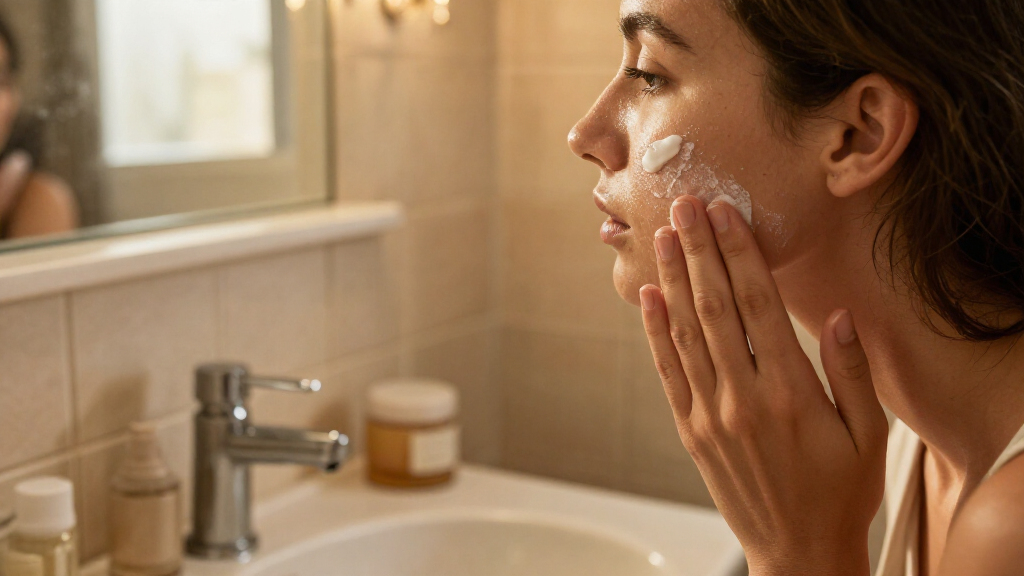
Advice about textured skin matters because attempts to make the surface smoother can themselves cause irritation. Koles says repeated scrubbing, frequent exfoliation and combining several acids can leave skin red, tight, flaky or stinging. Matheisz says she sees inflammation and weakened skin barriers among patients who use unsuitable combinations of AHAs and BHAs.
The report also flags a concern for darker skin tones: Matheisz advises particular caution with stronger glycolic acid concentrations, saying irritation and inflammation may raise the risk of post-inflammatory hyperpigmentation. That is her professional guidance in the article, not a personalized assessment for every reader. Anyone uncertain about a product or experiencing persistent irritation can seek advice from a qualified skin professional.
Picking and squeezing spots is another avoidable risk identified by Koles, who says it can contribute to pigmentation and scarring, particularly for people prone to breakouts. The practical message is not that texture must be eliminated, but that the cause and the skin’s response should guide any changes.
gentle fragrance-free face moisturizer for sensitive skin barrier
As an affiliate, we earn on qualifying purchases.
As an affiliate, we earn on qualifying purchases.
Different Causes, Different Care
The source report stresses that textured skin is normal and may appear temporarily. It can reflect ordinary skin processes, a change in environment or colder weather, as well as conditions that persist longer. Because similar-looking unevenness can have different origins, the article cautions against treating every bump or rough patch as clogged pores.
For congestion, Matheisz says a well-formulated salicylic acid product may help clear excess oil, dead skin and debris in pores. She cautions against using it in several stages of one routine or assuming it should be applied daily. The report recommends starting an exfoliating active a couple of times a week and watching how the skin responds, rather than increasing use quickly.
The article also says acids can be drying and should be paired with a nourishing serum or moisturiser to support the skin barrier. It does not provide a full treatment plan for every cause, nor does the supplied material establish that any particular product will work for an individual. The professional advice is to avoid experimenting with multiple acids when the cause or suitable combination is uncertain.
““The right acid, strength and frequency will be different for every skin.””
— Orsi Matheisz, advanced skin aesthetician and founder of Orskin Aesthetics
What the Advice Cannot Diagnose
The report does not say how common each cause is, how long improvement may take or which product strength is appropriate for a particular person. It also does not establish that exfoliating acids are suitable for everyone. Texture has multiple possible causes, and the article’s advice is general rather than a clinical diagnosis or individualized treatment plan.
The supplied source material ends during a section about dull or dehydrated skin, so it does not include the full set of recommendations from the original report. It also gives no publication date, supporting study data or independent comparison of products. Readers should treat the quoted guidance as professional advice reported by Glamour UK, not as proof that a specific routine will resolve their skin concerns.
A Cautious Way to Proceed
The approach described in the report begins with working out what may be causing the texture, then making limited changes rather than adding several active products at once. If using an exfoliating acid, its advice is to start at a low frequency, such as a couple of times a week, and monitor for redness, tightness, flaking or stinging. If those signs appear, the quoted experts advise pulling back.
Readers unsure whether their skin is congested, dry or reacting to products can seek an assessment from a qualified professional instead of combining acids at home. The source offers no timetable for results or follow-up milestone; the next step depends on the person’s skin response and the cause of the unevenness. Avoiding picking and over-exfoliation remains the clearest immediate caution in the report.
Key Questions
What does textured skin mean?
In the report, it means an uneven-looking or uneven-feeling surface. It can include roughness, small bumps, visible pores, dry patches or acne scarring, and the appearance alone does not reveal the cause.
Can exfoliating acids help with textured skin?
The article says acids may suit some causes: AHAs act on the surface, while salicylic acid, a BHA, may help with congestion in pores. The right acid, strength and frequency vary, and overuse can irritate skin. The report recommends a cautious approach rather than combining multiple exfoliants.
What can make skin texture look worse?
Koles warns that scrubbing, excessive exfoliation and layering acids can cause irritation, which may make texture more noticeable. Picking or squeezing spots may also contribute to pigmentation and scarring.
When should I ask a professional for advice?
Matheisz recommends a proper assessment when someone is unsure which products or acids to use. Consider seeking qualified advice if irritation persists or if you cannot tell whether the texture is linked to congestion, dryness, acne or another cause. The article does not provide a personalized diagnosis.
Source: rss
Halloween Picks
halloween
As an affiliate, we earn on qualifying purchases.